


Manhattan weddings
Live jazz in Manhattan for the wedding day itself
This page is for couples marrying in Manhattan who want a wedding jazz band, or a live jazz band for the wedding as a whole, for the parts of the day where people talk, eat and listen: the ceremony, the cocktail hour, a seated dinner and the first slow songs after it. Jazz bands for weddings do that part of the day well. If you are looking for a full reception band to keep a dance floor going until midnight, that is a different booking among the bands for hire in Manhattan, and we point you to it further down.
Manhattan weddings run on two clocks. One is New York State's: the marriage license you collect at the City Clerk's office on Worth Street cannot be used for a full day after it is issued, and it lapses after 60 days. The other is the day itself, which in this borough tends to be compressed into a few hours of a rented room. The jazz combo you hire has to fit both. Everything below is written from that angle, with the rules quoted from the Clerk and the state law, and the music described only from what LIV's own act profiles say.
LIV works from a single office, in Culver City, California, at 2651 Fairfax Avenue. We do not have a Manhattan office, and we say so up front because it changes how you plan with us: the first conversation is by phone, video or email, and the dates and times you send us are what the musicians build their day around.
Have a date, a ceremony time and a rough guest count? That is enough to check which of our jazz combos is free.
Check a wedding date- Acts by part of the day
- The Census and the Clerk, in one table
- Couples who marry later
- From the City Clerk to the first toast
- Jazz for the ceremony and processional
- Cocktail hour and dinner sets
- Dinner and dancing jazz
- Your own song requests
- The day, hour by hour
- Questions couples send us
- Nearby LIV pages
The roster
Which LIV jazz combo plays which part of a Manhattan wedding
Our acts are listed here in the order a wedding day usually meets them, from the quietest sound at the ceremony to the band that can carry dinner into dancing. Each description sticks to what the act's own profile states. You can book one of them for the whole day, or two: one for the ceremony and cocktail hour, another for dinner.
Blue Velvet, aisle to cocktails
Voice, strings, no drums
Blue Velvet is an acoustic act led by a singer, and its violin carries a processional well. Its profile lists ceremonies, cocktail hours and milestone dinners as the settings it was built for, and the repertoire runs from standards to recent songs arranged softly. For a wedding jazz trio that can play a processional and then move straight into the cocktail hour without changing personnel, this is the act we suggest first.
Meet Blue VelvetJaneiro, for a bossa nova hour
Brazilian, three or four players
Janeiro plays acoustic Brazilian music, bossa nova and samba above all, and sings in more than one language. Its wedding credential is press: Martha Stewart Weddings wrote it up in 2013 as a first choice for weddings. Its profile names "The Girl From Ipanema" and "Aguas de Marco" among its performance videos, so you know the kind of song it treats as home ground.
Meet JaneiroA saxophone among the guests
Solo saxophone, roaming or with a DJ
A single saxophonist can walk through a cocktail hour instead of standing in a corner, which matters in a room where guests are spread across a terrace and a bar. Later in the night the same player can join one of our DJs, so the sound of the cocktail hour carries into the dancing without hiring a second group.
Meet the saxophonistMood, for a swing-era dinner
Sinatra-era swing, seven in suits
Mood plays traditional pop and jazz in the manner of Frank Sinatra, with horn arrangements that go back to the swing era.
Meet MoodLIV Vintage, pop for the dinner sets
Pop songs in jazz clothes
Familiar pop songs, rearranged with a jazz feel, are what LIV Vintage does. It can be booked with more singers and a larger band than the one in its video, which helps when a couple wants the dinner sets to grow into something people get up for.
Meet LIV VintageRubato, dinner into dancing
Jazz that turns Latin late
Its base is jazz with blues and R&B; from there it goes into Latin territory, mambo and salsa, and into funk. The promo photo has eight musicians on it. LIV suggests it where a jazz cocktail hour should turn into Latin and funk dancing later, so it is the bridge between a jazz dinner and an evening that ends on its feet.
Meet RubatoIf the walk down the aisle should be classical, LIV also books a string quartet that plays the ceremony and then gives way to one of the combos above. For a broader look at our jazz roster outside the wedding setting, the jazz bands for hire page is the hub.
Not sure whether one act or two fits your day? Tell us where the ceremony and dinner happen and we will suggest a split.
Ask about pairing actsPublic records
What the Census and the City Clerk say about marrying in Manhattan
Each row is a published figure or rule, with the reason it matters to a band that is playing your wedding. Census rows describe New York County, the legal name for Manhattan, in the American Community Survey.
| Figure | What it changes on the wedding day | Source |
|---|---|---|
| 88.6% at 25 to 29 | Manhattan residents in their late twenties who have never married; nationally it is 67.6%. Weddings of couples in their twenties are the minority here. | ACS 2023 5-year, B12002 |
| 63.2% at 30 to 34 | Still never married in the early thirties, against 44.6% across the US. The typical couple on our Manhattan calendar has a working life behind it, not just a family. | B12002, US comparison |
| 48.0% at 35 to 39 | Close to half of Manhattan residents in their late thirties have never married (US 29.3%), so a wedding in this age group is ordinary here. | ACS 2023 5-year, B12002 |
| 32.2 and 30.5 | The typical New York groom marries for the first time at 32.2 and the typical bride at 30.5; nationally the ages are 30.6 and 28.7. This table exists for states, not counties, so read it as a New York State figure. | ACS 2023 1-year, B12007 |
| 47.3% live alone | Share of Manhattan households that are one person living alone (US 28.5%). Many guests arrive on their own and meet the rest of the room at the cocktail hour. | ACS 2023 5-year, B11001 |
| 28.1% born abroad | Foreign-born share of Manhattan residents, twice the US rate of 13.9%. Expect relatives flying in and song requests in more than one language. | ACS 2023 5-year, B05002 |
| 24 hours, 60 days | The wait after the license is issued and the life of the license. Your ceremony time, and so the band's first downbeat, has to land inside that window. | NY Domestic Relations Law 13-b |
Who is getting married
Manhattan couples marry later, and the guest list shows it
How far behind the national pace are Manhattan couples?
At every age band the Census reports, a larger share of Manhattan residents have never married than in New York City as a whole, the state or the country. The gap does not close with age. Among people aged 40 to 44, 37.6% of Manhattan residents have never married, while the national figure is 22.2% (our calculation from the same B12002 table). The chart lays the four age groups side by side.

The Census does not say why people here marry later, and neither do we. It is a description of who walks into the room: on average, a Manhattan couple is older on its wedding day than a couple in most of the country, and the music has to be planned for that crowd.
Who fills the guest list when the couple is in their thirties?
By the time someone marries in their thirties, they have usually spent a decade building friendships outside the family: colleagues, former roommates, people from a running club or a building they lived in. Manhattan adds a second factor. Almost half its households are a single person, as the chart below shows, which means a large share of the people a Manhattan couple knows live alone and are likely to come to the wedding alone.

For the band, that guest list has a practical shape. Groups that do not know each other need a cocktail hour where they can hear names. Tables mix friends from work with aunts from out of state. The dinner sets have to please both, without one half of the room feeling the music was chosen for the other.
Who makes the calls when the couple pays?
A couple in their thirties with careers is often the party that signs the vendor contracts, not their parents. That is reasoning from the age figures, not a survey, but it shapes how we work: we send our questions to the two of you, keep them short, and put the plan for the day in one written document you can forward to a planner or a venue coordinator without rewriting it.
What about the families who fly in?
Just over one Manhattan resident in four began life in another country, by the Census count in the table. So a Manhattan wedding has a better than average chance that one family, or part of it, arrives from abroad, with relatives who would rather hear a song they grew up with than another American standard. The request process further down this page asks for songs in every language the families speak, for that reason.
What does this mean for the music, in short?
- Plan a cocktail hour that helps strangers talk, because more guests arrive alone.
- Give friends from work and relatives from out of town music they can both talk over.
- Ask both families for songs, including songs in languages other than English.
- Send decisions to the couple first; they are usually the ones paying and approving.
On the ground in Manhattan
From the City Clerk at 141 Worth Street to the first toast
None of the license steps involve the band directly, but every one of them decides when the band plays. New York's rules are in Domestic Relations Law section 13-b; the procedures are on the Office of the City Clerk's marriage license page. We read both before writing this section.
Where does a Manhattan couple get the license, and how?
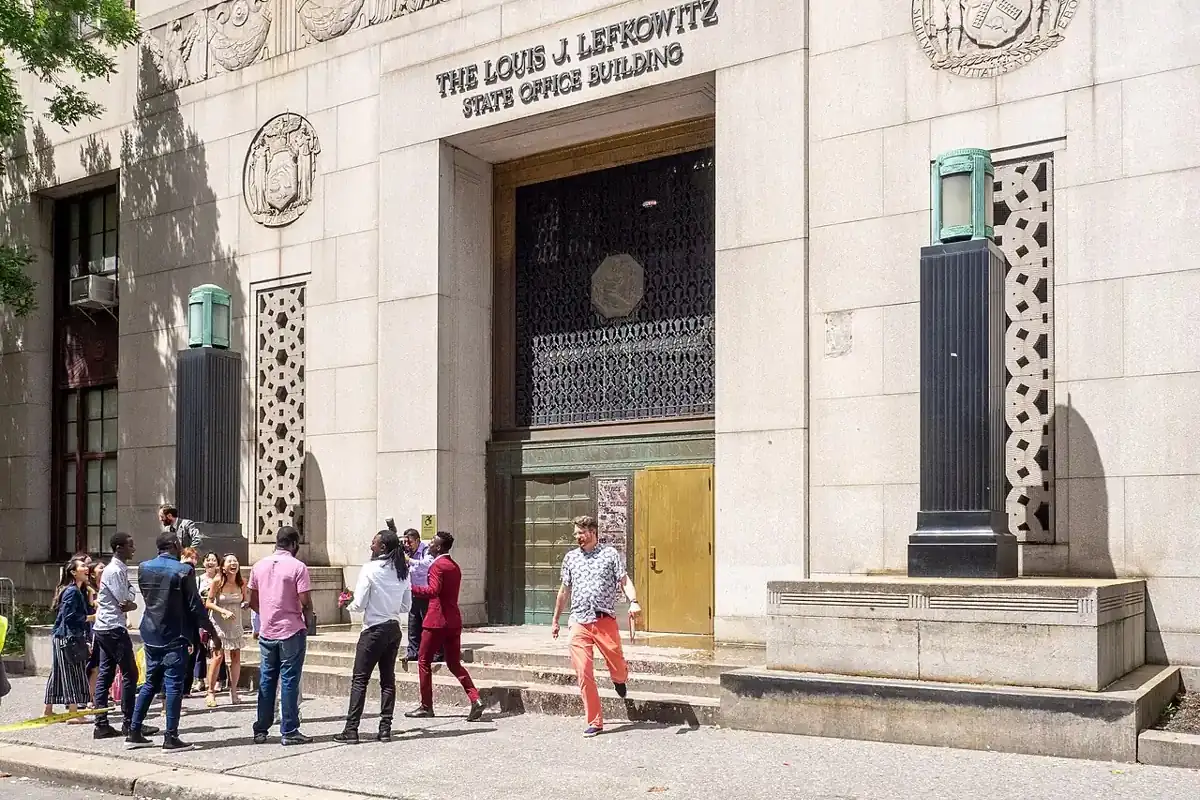
The Clerk's Manhattan office is at 141 Worth Street, New York, NY 10013, in the Civic Center, downtown. Its Marriage Bureau keeps hours of 8:30 am to 3:45 pm, Monday through Friday, according to the office locations page. The nearest subway stops the Clerk lists are Brooklyn Bridge on the 4, 5 and 6, Park Place on the 2 and 3, City Hall on the N and R, and Chambers Street on the A and C.
There are no walk-ins. Appointments for an in-person license, or for a virtual license interview, are booked through Project Cupid at nyc.gov/cupid. You start the application online, then both of you appear together, in person or on video, at the same time. Proxy marriage is not allowed in New York, so nobody can stand in for either partner. The fee is $35 by credit card or money order, and the Clerk does not refund it.



When can the ceremony start once the license is in hand?
Section 13-b says a marriage "shall not be solemnized within twenty-four hours after the issuance of the marriage license." The license itself has to state the day and the hour it was issued, and the person who marries you writes the date and hour of the ceremony onto it. So the wait is counted in hours, not calendar days: the earliest ceremony is at the same clock time on the following day.
A judge or justice of the state Supreme Court can order the wait waived. The statute lists the grounds: one partner in danger of imminent death, an emergency where the public interest is served, or a delay that would cause irreparable injury or great hardship. The Clerk asks couples to contact the Supreme Court about availability and to hand the waiver to their officiant, who attaches it when the license goes back. A tight schedule for a band is not a hardship in that sense, so we plan as if the full day applies.
How long does the license stay good?
The same section ends the window 60 days after issue. The Clerk's FAQ puts it as 60 days beginning the day after the license is issued. A New York City license works anywhere in New York State but not in another state, so a couple marrying in Manhattan with a license from Westchester or Long Island is fine, while a New Jersey wedding needs a New Jersey license. The chart shows the window.

What if we marry at the Clerk's office and celebrate later?
The Clerk performs civil ceremonies on site for $25, by appointment through Project Cupid, during business hours. The rules on the ceremony page are strict: you arrive together, bring the same identification you used for the license, bring at least one witness aged 18 or over, and the office currently allows only that one witness and no other guests. Arrive late and the ceremony does not happen. A Clerk wedding therefore has no room for musicians. Couples who marry at Worth Street and host a dinner the same evening or a few days later book us for the dinner, and the jazz becomes the first music the guests hear as a married couple walks in.
Who may marry you at a private ceremony in Manhattan?
Outside the Clerk's office you can marry anywhere in the state, with a religious or civil officiant who is allowed to solemnize marriages under New York law. Inside the five boroughs there is one extra step: the officiant must be registered with the City Clerk before the ceremony. Registration is done at the Manhattan office and costs $15, per the officiant registration page. Ask your officiant whether they are registered when you book them, because a problem here is not one any musician can play around.
What happens to the license after the last chord of the recessional?
At the end of the ceremony the officiant, the two of you and your witness sign the license. The officiant must then mail it to the Manhattan office within five business days. The Clerk mails the Certificate of Marriage Registration in about 20 days from when it receives and processes the license; if the certificate has not arrived a month after the wedding, contact the Clerk. For the music, the signing is the part that matters: it takes a few minutes, it happens in front of everyone, and it needs a short piece under it, which the next section covers.
License appointment booked? Send us the date and the ceremony time and we will hold the musicians for that window.
Hold musicians for my dateThe ceremony
Jazz for the ceremony and the processional
A ceremony is short, quiet and unforgiving. There is no second take of a processional, and the room is listening to every note in a way it will not during dinner. These are the questions we work through with a couple before a Manhattan ceremony, roughly in the order the music happens.
What should play while guests find their seats?
The prelude covers the time between the first guests arriving and the officiant standing up. It has no fixed length, which is why the timeline at the end of this page treats it as a stretchable block. Soft, familiar standards work well here, and so does bossa nova, which stays relaxed even when the room is half empty. Keep any song that matters to you for later; most guests are still finding a seat and talking.
How does a jazz combo time the processional to the aisle?
We ask how many people walk, in what order, and how long the aisle is. Then the processional piece is arranged with a point where the band can repeat a phrase until the last attendant reaches the front, and a clear change for the entrance of the couple. One person gives the musicians the cue: a planner, a venue coordinator or a friend with a good view of the door. Without a single named cue person, processionals start early or stall, and it is always the band that gets noticed.
If you want ideas for the entrance itself, LIV's guide to processional songs lists choices that translate well to a small jazz group.
Which act suits a ceremony in a small room?
- A voice and a violin for the entrance, then quiet standards after the vows: Blue Velvet.
- A processional in bossa nova rhythm: Janeiro.
- One instrument and no singer, in a ceremony room with little space: the solo saxophonist.
- A classical entrance with jazz from the cocktail hour on: the string quartet, then a combo.
Choosing the act this way, by what the moment needs, is different from choosing by how many people the room holds or deciding between a jazz duo for hire and a quartet. For the second question, our New York City jazz page covers sizing a jazz duo, trio or quartet to the space.
What does the band play while the license is signed?
Three sets of signatures go on the document in front of the guests, and a silent room makes those minutes feel long. We plan one short instrumental piece for this, at a lower volume than the processional, and stop it as soon as the officiant signals the pronouncement or the walk back up the aisle. Couples who sign privately beforehand can skip it.
How should the recessional hand over to the cocktail hour?
The recessional should be the brightest music of the ceremony: a faster tempo, a song people know, played until the last guest has left their seat. If the cocktail hour is in the same space, the band keeps playing without a break and moves into the first cocktail set. If guests move to another floor or another room, we either split the group or bring a second act, so there is no gap of dead air while the musicians pack up and walk.
Want a specific song for your entrance? Send it with your ceremony details and we will tell you how the act would arrange it.
Send ceremony detailsBetween the vows and the speeches
The cocktail hour and the dinner sets: background or featured
Most of the hours a jazz band spends at a Manhattan wedding are not the ceremony. They are the cocktail hour and dinner, and in those hours the important choice is between two modes. Background music sits under conversation and nobody is expected to watch. A featured set asks the room to turn and listen. A good wedding day uses both, on purpose, and the couple decides where the switches happen.
How loud should a cocktail hour be when guests do not know each other?
The guest list described earlier, with many guests on their own and tables that mix friends from work with relatives, makes the cocktail hour the place where introductions happen. That calls for background mode: the band plays at a level that lets two people standing a few feet apart talk without raising their voices. Acoustic acts such as Blue Velvet and Janeiro sit there naturally. A louder act can play this hour too, but we would then trim the lineup or the amplification for it.
What happens to the music while the couple is away for photos?
If you leave the cocktail hour for portraits, in Manhattan that can mean a car to a rooftop, a park or a street corner you like. Traffic decides when they come back. The cocktail sets are therefore built in blocks the band can extend, and the musicians do not save the songs you care about for this hour. LIV has a separate guide to keeping guests entertained during photos.

Should the saxophone roam or stay on the stage?
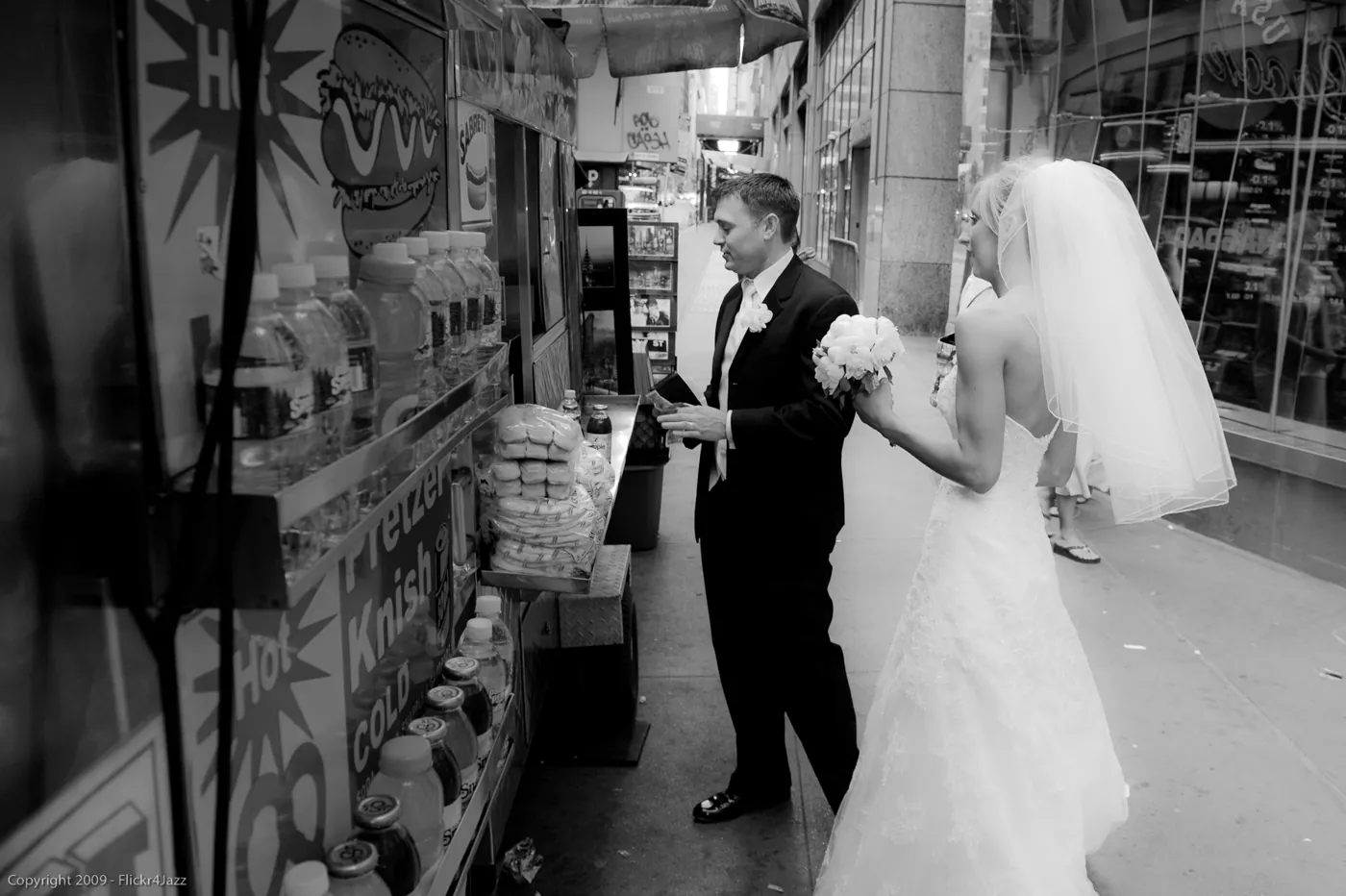
A roaming sax works when guests are spread across rooms or a terrace and no single spot reaches all of them. It also works when space is tight, because one player needs no stage. It does not work during dinner service, when servers need the aisles. We usually suggest roaming for the first part of the cocktail hour and a fixed spot near the dining room door for the last part, so the music leads guests in to dinner.
How do dinner sets fit around courses and toasts?
- Seating: a featured song as guests find their tables, so the room settles.
- First course: background sets at the lowest level of the night.
- Toasts: the band stops completely and waits for the cue to come back in.
- Main course: background again, with a few songs requested by the families.
- Before dessert: a featured set, if the couple wants one, before any dancing starts.
Courses and speeches run on the caterer's schedule, not the band's. We ask for their run sheet and fit the sets to it, rather than asking them to fit their service around the band.
When does a featured set make sense?
A featured set fits when the couple wants the guests' attention on something: a parent dance, a first dance done at the dinner tables, a toast that ends on a song, or a few numbers from a singer before the cake. Featured moments land when they are short. Long featured sets in the middle of dinner turn a wedding into a concert, and the conversation that a Manhattan cocktail hour started gets cut off.
Can the band announce anything?
The bandleader can make short announcements, such as calling guests to dinner or introducing the couple, if you ask. Many couples prefer the planner or a friend to speak, with the band playing a short phrase to mark the moment. Tell us which you want, and spell any names we will say out loud.
After dinner
Dinner and dancing jazz, and the moment to hand over
Some couples want the jazz band for dinner and dancing: a seated meal that turns, without a change of musicians, into an hour or two of partner dancing. That is a real format with its own limits, and it is different from a dance band for the reception.
What does "dinner and dancing" mean for a jazz band?
A jazz band for dinner and dancing plays two kinds of sets with the same musicians. During dinner it is in background mode. After dinner it raises the tempo and plays songs people can dance to with a partner: swing, standards with a beat, bossa nova and samba, Latin numbers. The dance floor that results is a ballroom-style floor, where couples of every age can dance together, not a club floor.
Which LIV acts can carry dinner into dancing?
- Swing-era partner dancing with a horn section: Mood.
- A floor that should tip toward Latin dancing once it fills: Rubato.
- Dancing to songs the couple's friends know, with extra singers added after dinner: LIV Vintage.
- An acoustic floor that stays Brazilian: Janeiro, playing samba.
What about a Dixieland or swing band for the dancing?
Some couples name a style instead of an act: Dixieland, say, or swing bands for hire in New York. Mood covers the swing-era sound from our roster. Our New York City jazz page sets out the jazz styles we can bring across the five boroughs, including traditional New Orleans and Dixieland lineups, so we do not repeat that menu here.
When should the jazz band hand over to a full band or a DJ?
Hand over when the guests want to dance in a way that a jazz combo is not built for: long runs of current hits, a packed floor at high volume, or several hours of dancing. At that point a reception dance band or a DJ is the right tool. If you want a full band for the second half of the night, our page of live bands for hire in New York, for events and wedding receptions in NYC, covers reception bands. If a DJ takes over, our saxophonist can stay on and play over the DJ's tracks, so the jazz from earlier in the evening does not disappear; the Manhattan DJ page covers that side.
How do we avoid a dead gap at the hand-over?
The outgoing band plays a final song that the incoming band or DJ can start from at a similar tempo. Both acts know the exact time and the song, and the incoming act is set up and checked before the jazz band finishes. In a Manhattan venue with one room and no second stage, that set-up needs to be planned with the venue in advance, because two acts may have to share a small floor for a few minutes.
Is a jazz band right for a private party around the wedding?
A jazz band for a private party is one of the easier bookings on a wedding weekend: the rehearsal dinner, a welcome drink for guests who flew in, or a brunch the morning after. These are background events almost by definition, so a duo or the solo sax often covers them. Ask about them when you ask about the wedding date, so we can check the same musicians for both.
Planning dinner and dancing with one band, or a hand-over at nine? Tell us which and we will plan the sets around it.
Plan dinner and dancingSong choices
Your own song requests, and how a Manhattan combo prepares them
Couples who plan their own wedding usually arrive with a short list of songs that matter to them: one for the walk down the aisle, one for the first dance, perhaps one from a family's home country. Those requests are where a small jazz group needs the most preparation, because each one has to be arranged for the instruments that will actually be in the room.
Which songs carry a cue in the ceremony?
Two songs in a ceremony are cues, not background: the one the couple enters on and the one they leave on. Send those two first, with the version you have in mind. The band marks in each arrangement where it can repeat and where it can end cleanly, because the entrance song has to stop when you reach the front, not when the recording would.
How does a first-dance song become a trio arrangement?
A first dance is usually a recording with a full band, strings or a producer's beat behind it. A wedding jazz trio cannot copy that; it plays the melody and harmony with three instruments and a voice if the act has one. Tell us whether you want it close to the record or turned into a jazz ballad, and how long you want to dance. We agree the arrangement and the length before the date, and the band rehearses only that version.
What about a song in another language?
A couple with one family raised abroad often asks for a song in Portuguese, Spanish, Italian, Hebrew or another language. Brazilian songs are home ground for Janeiro. For other languages, send a recording and the exact version early, so we can tell you honestly whether the act can perform it well or whether an instrumental version is the better choice.
How much notice does the band need to learn a new song?
Usually, yes, a combo can learn a song it does not already play, given a recording, the key you want and enough time before the date to rehearse it. Send new songs with your booking details rather than in the final week, so there is room for one round of changes if the first arrangement is not what you pictured. Very new songs in styles far from jazz are the hardest, and we would rather suggest an arrangement than promise a copy of the record.
Should we write a list of songs not to play?
Yes. A short do-not-play list protects you from a song tied to a bad memory for one of you, and from well-meant guest requests on the night. The bandleader keeps it and checks every guest request against it.
Who decides about requests on the day?
Name one person, other than the two of you, who can say yes or no when a guest asks the band for a song. A sibling or the planner is fine. Without that person, the bandleader has to judge alone whether a request fits your night. Our page of wedding request songs gives you a starting list if you are short of ideas.
- The entrance and exit songs, with the versions you mean.
- The first-dance song, its style and how long you want to dance.
- Any song in another language, with a recording.
- Anything new for the musicians, attached to the booking email.
- The do-not-play list.
- The name of the person who approves requests on the night.
A sample Saturday
A Manhattan wedding day, hour by hour, and where it slips
The times below are an example, built for one Saturday afternoon ceremony with dinner in the same building. Your schedule will differ. What stays the same is the pattern: each step has a typical way of running late in Manhattan, and each has something the band can prepare for it.
Weeks before
The license appointment on Project Cupid
What can slip: appointments are booked through nyc.gov/cupid, late arrivals may not be admitted, and a couple who cannot get a weekday slot that suits them pushes the license closer to the wedding than they intended.
How the combo plans for it: nothing on our side depends on the license date, so the musicians are held for your wedding date from the day you book. We only ask for the hour of issue once you have it.
Thursday, 2:40 pm
License issued at 141 Worth Street
What can slip: the clock starts at the printed hour. A couple who picked up the license on Friday afternoon for a Saturday lunchtime ceremony would be inside the 24 hours.
How the combo plans for it: if the ceremony has to move later in the day, the band's ceremony set moves with it and the cocktail hour shortens, not the other way round.
Saturday, 2:45 pm
Musicians ready, prelude begins
What can slip: guests coming across town arrive in waves, and the first ones may be seated half an hour before the start.
How the combo plans for it: the prelude list is longer than the time on paper, and the band stops on the cue, not at the end of the list.
3:30 pm
Processional
What can slip: the start drifts while the last guests arrive, and the attendants walk faster or slower than in rehearsal.
How the combo plans for it: one named person cues the band, and the processional has a phrase the musicians can repeat until the couple appears.
3:55 pm
Signing the license
What can slip: the officiant, the couple and the witness all have to sign, a pen goes missing, and the room watches in silence.
How the combo plans for it: a short, quiet instrumental is ready for exactly this, and it ends on the officiant's signal.
4:00 pm
Recessional into the cocktail hour
What can slip: the couple leaves for portraits and comes back later than planned because of traffic.
How the combo plans for it: cocktail sets are built in blocks that can stretch, and the songs the couple cares about are kept for when they are in the room.
5:15 pm
Guests seated for dinner
What can slip: the toasts run long or move between courses, and someone starts speaking without a microphone over the music.
How the combo plans for it: the band follows the caterer's run sheet, stops fully for every toast, and comes back in only on the agreed cue.
6:30 pm
The featured set
What can slip: the couple are mid-conversation at a far table when the featured song is due, and the room is not watching.
How the combo plans for it: the bandleader checks with the cue person that the couple are in place before counting in, and the band holds a soft vamp until they are.
7:00 pm
Dinner and dancing
What can slip: the floor fills faster than planned and guests start asking for music the combo does not play.
How the combo plans for it: the requests list and the do-not-play list go with the bandleader, and the hand-over time to a dance band or DJ is fixed in advance, with its final song agreed.
8:30 pm
The last dinner set
What can slip: the party is going well and someone asks the band to keep playing past the booked time.
How the combo plans for it: the couple names in advance who can approve extra time, so the bandleader has a clear yes or no, and the venue's own closing time is already known.
Send us your own run of the day, even a rough one, and we will mark where the music needs a plan B.
Send my wedding timelineQuestions
What Manhattan couples ask before they hire a jazz band for a wedding
Is a jazz duo enough for a Manhattan wedding, or do we need a trio or quartet?
For a ceremony plus a short cocktail hour, two players are enough; a jazz duo for hire in New York does that job. A jazz trio adds a bass line that keeps dinner music moving, and jazz quartets for hire, or a larger jazz ensemble for hire, give you the volume and range for dinner and dancing. The decision depends on which parts of the day the group plays. For lineup sizes against room sizes across the city, see our New York City jazz page; on this page we plan by moment.
Can the wedding have a singer, and when should the voice come in?
Yes. Among jazz singers for hire in New York through LIV, Blue Velvet, Janeiro, LIV Vintage and Rubato all perform with vocalists, and Mood's set is the crooner songbook. The wedding question is when the voice comes in. A singer during the processional competes with nothing, but a singer under spoken vows competes with the officiant, so we usually keep the ceremony instrumental from the vows to the pronouncement and bring the voice back for the recessional and the cocktail hour.
Can a friend officiate our wedding in Manhattan?
Yes, through the City Clerk's One-Day Marriage Officiant License. Any person aged 18 or over can apply, and they do not have to live in New York. The application goes to the same Clerk's office that issued your license, and only after you have the license. All of the city's applications are processed at the Manhattan office. The fee is $25, and a notarized application can be mailed with a money order instead of applying in person. The license must be issued before the ceremony, covers only your marriage, and ends at the ceremony or when your marriage license expires, whichever comes first. Source: the Clerk's one-day officiant page.
We are marrying at the City Clerk on a weekday and celebrating on Saturday. Can the band play a second ceremony?
Yes. The Clerk's FAQ notes that many couples have a civil ceremony before a religious ceremony, and that you may marry the same person more than once. For the band, a symbolic or religious ceremony on Saturday is planned exactly like any other: prelude, processional, the vows, a recessional. The only part that changes is the license signing, which already happened at Worth Street, so there is no signing piece unless your officiant has their own document to sign.
We spotted a typo on our marriage license. Does it affect the wedding plans?
It need not. The Clerk corrects a license free of charge within the 24 hours after it is issued; after that, a correction costs $25. If the license is lost or damaged, a duplicate also costs $25 and needs a new appointment. Active members of the armed forces get a license that lasts 180 days instead of 60. None of this changes the band's booking, but a duplicate appointment late in the window can push the ceremony time, so let us know if it happens. Details are on the Clerk's marriage FAQ.
One of us was born abroad. What record do relatives overseas usually need?
The Clerk issues an Extended Certificate for Foreign Use, which adds both partners' parents and their countries of birth, the officiant's name and title, and the ceremony location. It is the version typically used abroad for passports, adoption and dual citizenship applications, and it costs $35. The standard short certificate costs $15. If relatives are traveling in for the wedding, it is worth ordering the extended version once the marriage is registered.
Do LIV's musicians live in New York, or travel in for the wedding?
This question usually arrives worded as a search: a local jazz duo, jazz bands for hire near me. Our bands are based in Los Angeles and are available for hire across the country and abroad, so for a Manhattan wedding they come to you. For the mechanics of flying musicians across the country, read the Chicago page in our live bands section. For you, the practical difference is that we confirm timings in writing well ahead, because the musicians build their trip around them.
Can we book an acoustic trio for a small ceremony at home or in a restaurant?
Yes. An acoustic trio for hire in New York is the format Blue Velvet offers, and it fits a ceremony in a restaurant's private room or a small gallery. What we need from you is the exact spot the musicians will stand, and the time the room opens to vendors. If the venue sends rules for vendors, forward them to us so the musicians have them before the day.
Do you have world music bands or salsa bands for hire in New York for a wedding?
Within the jazz roster above, the Brazilian and Latin-leaning acts cover the earlier parts of the day. If your families want a full salsa band or a band from another tradition for the reception, say so in your first message. We will tell you plainly whether we have the right act or whether a jazz group for the earlier parts of the day is the better fit.
Can we change the timeline after we book?
Small changes, such as moving dinner by 20 minutes or swapping the order of toasts, are normal and we adjust to them up to the week of the wedding. Changes to the total hours, the start time or the number of musicians can change the quote, because they change what we booked the musicians for. Send the final run sheet from your planner or venue the week before, and the bandleader will work from that version.
What do we send to hire a jazz band for our wedding?
Whether you think of it as a jazz band rental or a booking, send the date, the venue or the neighborhood, the ceremony start, the end time and the parts of the day you want music for through our contact page. Our answer lists the acts that are free on your date, with a quote attached. Once you confirm, we ask for the details covered on this page: the cue person, the processional order, requests, the do-not-play list and the name of the person who approves extra time.
Is a Manhattan jazz band only for weddings with a big budget?
No. The smallest booking we describe on this page is a single saxophonist for a cocktail hour, and a small dinner after a Clerk ceremony is a common reason to hire jazz musicians in Manhattan. Scaling down means fewer musicians and fewer hours, not a lesser player. Tell us the budget range when you first write, and we will suggest the format that fits it instead of quoting the largest version first.
Can we hire a big band for a Manhattan wedding instead of a combo?
The acts on this page are combos and mid-size groups, with Rubato the largest. A full big band, with a horn section of its own and a conductor, is a different kind of booking, and it needs a room with a stage and a floor to match. If that is the sound you want for the dinner and dancing, tell us in your first message. We will answer plainly whether we can staff it for your date, and if a smaller group would serve the day better, we will say that instead.
What if our ceremony and dinner are in two different Manhattan venues?
Then the travel time between them decides the plan. If guests move from a ceremony venue to a dinner venue, the band that played the ceremony cannot also be playing when the first guests arrive at dinner. The usual solutions are two acts, one at each place, or a solo saxophonist at the second venue who starts the cocktail hour while the main group moves. We plan this once we know both addresses.
Close by on our site
Jazz and wedding music For Hire Near You around Manhattan
- Live jazz bands for hire in New York CityJazz lineups and styles across all five boroughs
- Live jazz bands for hire on Staten IslandAcross the harbor from Lower Manhattan
- Live bands for hire in ManhattanFull bands for the same borough
- Live bands for hire on Staten IslandFull bands one ferry ride away
- DJs for hire on Staten IslandA DJ for the night across the harbor
- Jazz bands for hireThe full jazz roster, sorted by act