We use cookies to run this site, measure traffic, and serve relevant ads. Choose which categories you allow. You can change this any time. See our Privacy Policy.
Cookie preferences
Choose which cookies you allow. You can change these at any time from the "Cookie preferences" link in the footer.
Strictly Necessary
Required for the site to function (session, security, form submissions). Cannot be disabled.
Always on
Analytics
Help us understand how the site is used (e.g., Google Analytics). Aggregated, no individual identification.
Marketing
Used to measure ad effectiveness and show you relevant ads on other sites (e.g., Google Ads, Meta Pixel).
Functional
Enable enhanced features like live chat and remembering preferences.
Session replay
Records how you scroll and click on our pages so we can spot what is hard to use (Microsoft Clarity). Off unless you turn it on.
Wedding, company and private-party bands flown in from Los Angeles for Boston's ballrooms, library halls and harbor decks, with the date, the room's rules and the travel planned together.
A session and orchestral harpist whose credits run to Dionne Warwick and Barry Manilow. She needs a chair and a few feet of floor, so she fits a chapel-sized room.
Built around chart songs and classics, with sets from seven traditions, among them Persian, Armenian, Indian and Russian. At 18 pieces it becomes a staged show with costume changes.
Boston's short outdoor season, and the weekends other events claim first
A band can play Boston in any month, but the month decides where it plays. Snow and cold push most of the year indoors, the warm stretch is short, and a handful of weekends belong to the city's big events. Settle the date with those three things in mind, and the band and the room fall into place behind it.
June to September: the four months when the evenings stay warm
NOAA's 1991 to 2020 normals for Boston Logan put the average overnight low at 59.7°F in June, 66.0°F in July, 65.1°F in August and 58.2°F in September. Those are the only four months when a terrace reception, a courtyard dinner or a harbor cruise can stay outside after dark without heaters. A ceremony act such as the string quartet or Janeiro can play outdoors in this window, with the dance band waiting inside or under a tent.
Rain doesn't take a season off here. The same NOAA record gives Logan 9 to 12 days with measurable rain in every month, July and August included, so any outdoor plan needs a covered spot the band can move to quickly. Agree with the venue in advance where that spot is, because the band's cables and speakers need a dry, powered place, and that is a different request from moving the chairs.
June to September are the months whose nights average 58°F or warmer; December to March each average 9 inches of snow or more. Built from NOAA's 1991 to 2020 normals for Boston Logan.
October: the colorful month with the cold evenings
October brings the foliage, and it is a busy wedding month across the country: The Knot's Real Weddings Study counts October and June as the two most popular wedding months, at 16% of weddings each. In Boston, October's average low drops to 47.5°F. Photos can happen outside in the afternoon light; the band, the dinner and the dancing belong indoors. If a Saturday in early October is the plan, hold it early, because it is in demand nationally as well as locally.
December to March: snow on the calendar
The same NOAA record gives Logan about 14 inches of snow in January and again in February, and 9 inches each in December and March. A winter wedding or holiday party in Boston is an indoor event by default, which suits the ballrooms and the library rooms described further down. What changes is the travel. The players fly in from Los Angeles, and a storm can close runways or slow the drive from the airport to the venue, so for a winter date the arrival is planned with more slack than in June.
The weekends Boston gives to someone else
A few dates bring large crowds into the city. On those weekends the problem is rarely the band; it is hotel rooms for the players and your guests, road closures near the venue and the time a van needs to cross town. These are the ones to check before you sign anything:
Boston Marathon, Monday, April 19, 2027. The B.A.A. runs the 131st race on Patriots' Day. Race-day street closures and the crowds around it are worth checking before you put a Back Bay reception on that weekend.
Commencement season in May. Northeastern holds its Boston ceremonies at Fenway Park on Saturday, May 8, 2027; Boston University runs commencement from May 13 to 16, 2027; Harvard's commencement is May 27, 2027. Each one brings graduates' families into town on those weekends.
Head of the Charles Regatta, October 22 to 24, 2027. The regatta lands on a late-October weekend that couples also want for foliage weddings.
First Night, December 31, 2026.First Night Boston fills Copley Square on New Year's Eve, the same night many companies and families want a band for their own party.
None of these rules a date out. They decide how early to commit: on any of these weekends, ask the venue and the band at the same time.
Holding a Saturday in June, September or October, the months most couples want? Send it now and we check which acts are still free.
Nathan and his company provided excellent service and resources both for our engagement party and the wedding itself. He heard all of our music suggestions and was available for multiple meetings. When the venue came with restrictions, Nathan countered with amazing ideas to make our ceremony and celebration unique. His energy is contagious, and his band is exceptional.
Our wedding was such a magical day. Rouge was amazing! They went above and beyond what we expected for our Persian/Mexican mixed wedding. The best part of our night dancing on stage with ROUGE overlooking 300 people on our dance floor sharing the magical night with us! We are incredibly lucky to have had them be apart of our wedding day! Highly recommend.
This company deserve more than 5 stars. If you are lucky enough to hear about them before your wedding, don’t doubt they are absolutely phenomenal. It’s. been over a month after our wedding and we still getting calls from our guests about how magical our wedding was. I can’t say enough about Rouge’s performance. The most professional, experienced, awesome people to work with
Library, ballroom, museum, park
Boston wedding venues and the conditions each one sets for the band
Many of the rooms Boston couples want are old, protected or public buildings, and they come with written rules for outside vendors. A wedding band from out of town has to meet them the same way a local one would, and the rules decide the line-up as much as the guest list does. Four places show the range: what each publishes, and what we change in the booking because of it.
The Central Library in Copley Square: a palace with a weekday loading dock
The Boston Public Library rents its McKim building for private events after hours. Its 2025 pricing guide lists the whole building at 1,300 guests and Bates Hall at 330 seated; the Guastavino Room seats 180, or 150 once a dance floor goes in, and the Abbey Room seats 100, or 70 with dancing. The courtyard holds 225, or 200 for a ceremony. Those dance-floor numbers are the ones to plan the band around: a 150-guest reception in the Guastavino Room suits a compact dance band, not a stage show.
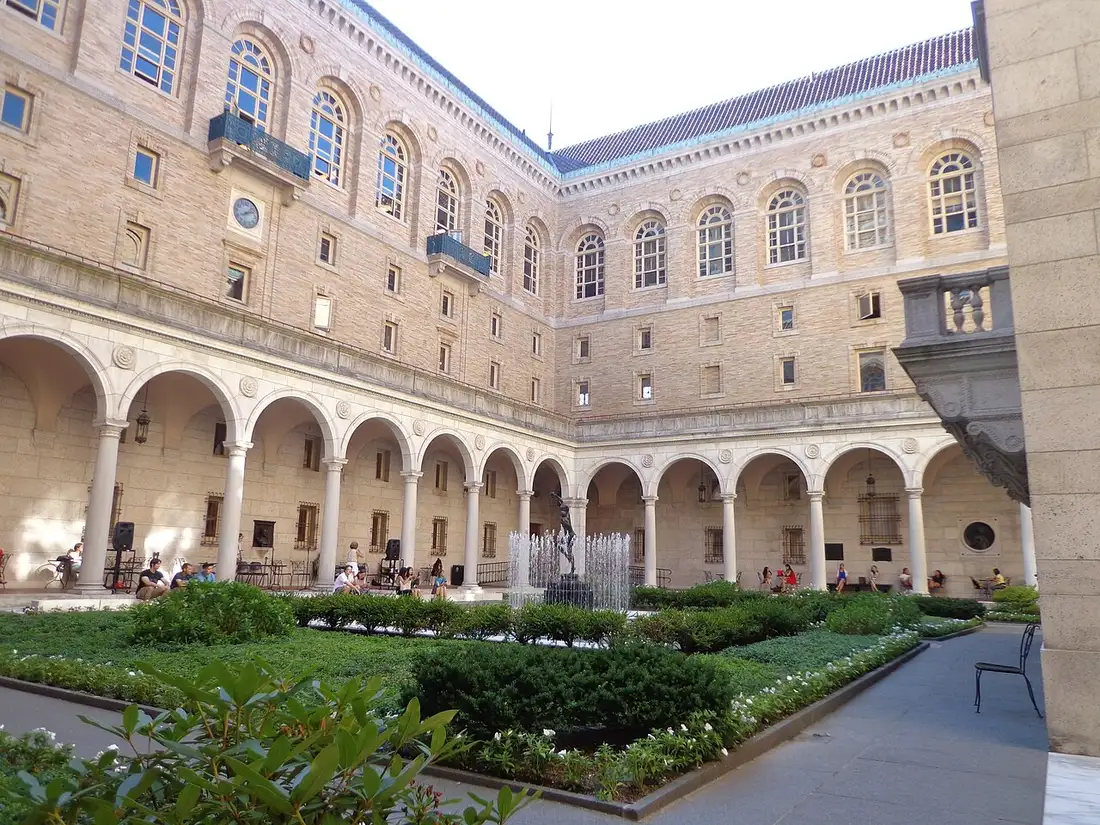
The McKim courtyard in summer, with its arcade, fountain and lawn. Photo: Dbli4805, CC BY-SA 4.0, via Wikimedia Commons.
The library's private event procedures spell out what a band must do. The band must know the event's end time and the limited electrical power in the room; it brings its own extension cords and cables and tapes them down without duct tape; and the public elevators cannot be used to move equipment. The loading dock on Blagden Street opens 8 a.m. to 4 p.m., Monday to Friday, deliveries need two weeks' written notice, and the vendor list goes to the library at least 45 days before the event. The bars close 30 minutes before the end, so the last set is planned around a room that has stopped serving. Events run after hours for a reason: the same document says music isn't allowed in the library during opening hours without advance written permission, and only acoustic music in limited spots even then. Space fees are charged in four-hour blocks, so a long set-up and sound check come out of the time you are paying for.
What that means for your booking: for a Saturday wedding, the band's equipment delivery has to be agreed with the library well ahead, since the dock is closed on weekends, and the power limit is settled before we decide how big the sound system can be. The band's insurance certificate also has to name both the City of Boston and the library as additional insured, with at least $1 million in general liability, as the procedures require. We ask for those details first, because they fix the line-up before anyone chooses songs.
The Fairmont Copley Plaza: a 580-seat banquet ballroom under thirty-foot ceilings
Across the square, the Fairmont Copley Plaza's wedding page lists 1,100 guests as the hotel's largest event capacity; its Grand Ballroom seats 800 theater-style or 580 at a banquet, under gilded thirty-foot ceilings, and a 2,295-square-foot foyer for the cocktail hour; the St. James Room takes up to 120. Under a ceiling that high, with 580 at dinner, the horns and extra singers of a large Rouge line-up still reach the back tables. The foyer is the natural place for the ceremony group or Janeiro to play while the ballroom is turned for dinner. For a 120-guest wedding in the St. James Room, the same couple would be better served by LIV Vintage or Legendary than by an 18-piece show.
The Museum of Fine Arts: a courtyard designed with a sound engineer
The MFA's events page describes the Shapiro Family Courtyard as 13,000 square feet under 63-foot ceilings, with acoustics designed with a sound engineer, and says the museum hosts holiday parties for several thousand guests. A hard-surfaced space that tall carries sound a long way, which favors acoustic acts for the reception hour: the string quartet, Deux Cellos or the harp can fill it without being turned up. A dance band in that room needs an unhurried sound check, because the hard walls and the height change how loud it sounds at the tables.
Choosing between the Copley ballroom and a smaller room for the reception? Send both guest counts and we tell you which line-up suits each.
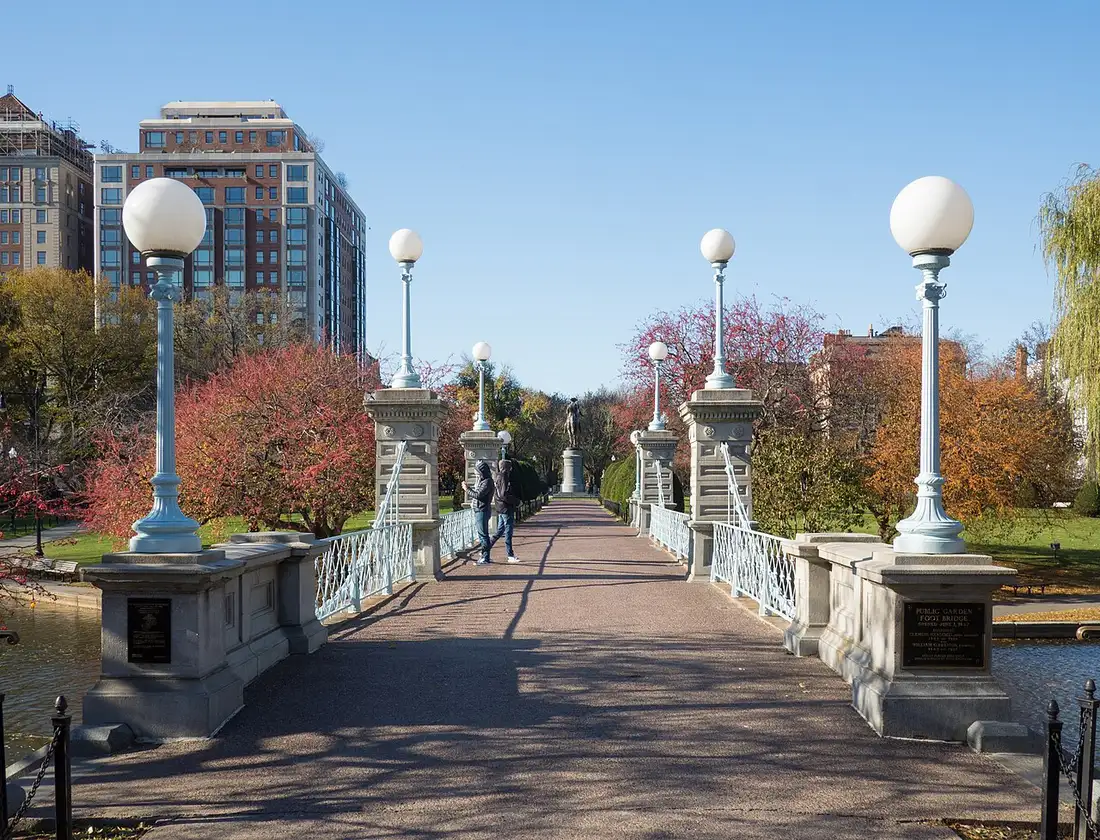
The footbridge over the Public Garden lagoon in autumn, with Back Bay beyond the trees. Photo: Rhododendrites, CC BY-SA 4.0, via Wikimedia Commons.
A Public Garden or Common ceremony: the music starts after the vows
If the vows are planned by the lagoon, read the rules first. The City's wedding and photography policy for the Common, the Public Garden and the Commonwealth Avenue Mall, as published by the Friends of the Public Garden, allows ceremonies from April 1 to December 1, for 60 minutes at most and 50 people at most, weekdays 3:00 to 5:30 p.m. and weekends 11:00 a.m. to 5:30 p.m. No chairs, arches or tents, and no music or amplified sound. The permit costs $50 for Boston residents and $100 for everyone else, with the application due at least 10 business days ahead. The same rules apply to Christopher Columbus Park on the waterfront.
So a park ceremony has no musicians at all. The music moves to the reception: the quartet or the harp plays as guests arrive from the park, and the processional song you had in mind can be the first one they hear inside.
Four more rooms couples ask about, and what each allows
Four Seasons One Dalton
Two ballrooms on one floor
The hotel's fact sheet lists the Beacon Ballroom at 300 for a reception or 190 at a banquet and the Clarendon at 200 or 120, both on the third floor, and its wedding page suggests one room for the ceremony and the other for the reception.
For the band: the ceremony group plays one room while the dance band sets up in the other, with no second venue to travel to.
Isabella Stewart Gardner Museum
Receptions, not weddings or dances
The museum's event rentals page says it can't host wedding ceremonies or receptions, bar or bat mitzvahs, or dances. Its Cloisters take a reception of up to 200, and Calderwood Hall, its performance space, is rented by the half hour and only together with a reception space.
For the band: a company or milestone reception here suits the string quartet or Janeiro; a dance band does not fit the museum's rules.
New England Aquarium
A gallery all year, a terrace in season
The aquarium's events page gives its main exhibit gallery 800 for a cocktail reception or 375 seated, year-round, and its venue list puts the Harbor View Terrace and Tent at 350 or 275 seated, from April through October only.
For the band: an outdoor set on the terrace belongs to the warm months covered in the date section; the rest of the year, the music moves into the gallery.
Boston Athenaeum
Booked through its caterer
The library's events page lists weddings among the gatherings it hosts and sends every inquiry and booking through its exclusive catering and events partner, The Catered Affair.
For the band: the music plan, set times and load-in go through the caterer's event manager, so that is the contact we coordinate with.
Both museums list smaller rooms too, which suit a rehearsal dinner or a client reception with acoustic music. The Gardner's rentals page gives Café G 150 for a reception or 90 seated, Calderwood Hall 296 across the full hall or 120 on the stage level at $1,000 per half hour, and the whole museum for an evening at $30,000. The aquarium's venue list puts the Simons Theatre at 378 seats, with its lobby taking 140 for a reception or 100 seated, a size that suits Janeiro or the string quartet before a screening or a talk.
Already holding the library, the Copley ballroom or a park permit? Send it to us and we work out the line-up that fits its rules.
Corporate live bands in the Seaport, and private parties from the harbor to the living room
The largest rooms on this page are in the Seaport, where the convention center and the Omni face each other on Summer Street. They are huge, and the size is not the hard part for a band. The hard part is the paperwork: who is allowed to supply sound, which power the band can plug into, and which crew handles the stage. Each of these rooms answers those questions differently, in writing.
The convention center: bring your own speakers
The Thomas Michael Menino Convention & Exhibition Center, still often called the BCEC, publishes a 2026 event planning guide. Its Grand Ballroom is 40,020 square feet of column-free space under a ceiling that peaks at 32 feet, and it divides into two rooms of 20,010. The building's own vendors are the only ones allowed to supply electrical service, the house sound system, rigging and truss. Any other audio company must be approved in advance and must bring a stand-alone speaker system. For a band, that settles two things before the contract: our sound and lighting crew has to be cleared by the building ahead of time, and the band's power comes through an order placed with the center, not an outlet on the wall. The guide also sends labor work-rule questions to the union local's business agent, so the loading and staging schedule is agreed with the building in advance, not improvised on the night.
A LIV singer on stage. At the convention center, every microphone on that stage runs through the building's approved audio vendor or a stand-alone system an approved company brings in. Photo: LIV Entertainment Group.
The Omni Seaport ballrooms: capacities that assume no stage
Across Summer Street, the Omni Boston Hotel at the Seaport lists its Ensemble Ballroom at 25,585 square feet, with 2,129 guests at a banquet or 2,586 at a reception, and the Momentum Ballroom at 17,039 square feet, 1,418 at a banquet. The specification sheet adds that the numbers allow for minimal audiovisual equipment. A band stage, a dance floor and a front-of-house sound desk take tables out of that count, so a company booking near the room's limit should ask the hotel for a floor plan with the stage drawn in before it confirms the guest list. That floor plan is also where a staged show's width gets checked, since choreographed singers need more stage than a seven-piece band.
Artists For Humanity in South Boston: a gallery with eight circuits
For a smaller company party or a launch, the Artists For Humanity EpiCenter takes from 40 people for a meeting to 800 for a cocktail reception. Its rental toolkit gives the Lewis Gallery 5,000 square feet, 18-foot ceilings, eight 20-amp circuits and ground-level load-in. Ground-level load-in makes the band's set-up quick. Eight circuits cover a band with its own sound comfortably; a large lighting rig on top of that is a question for our lighting and AV crew before the day.
Back Bay's convention hall and hotels, and the City's own hall
Hynes Convention Center
Same authority, same speaker rule
The Hynes in Back Bay is run by the same state authority. Its specs page lists a 24,544-square-foot ballroom seating up to 3,190, 14 weather-protected loading docks and a green room for entertainers, and its exhibitor rules make outside audio companies bring a stand-alone speaker system and send all freight through the dock. Glitter and confetti are banned.
For the band: gear enters at the dock, never through the lobby, and any confetti moment is off the run of show.
Boston Marriott Copley Place
A dock with no forklift
The hotel's events page describes a Grand Ballroom of more than 23,000 square feet seating up to 2,600. Its load-in sheet puts the dock on Harcourt Street with 14'4" clearance and no lift gate or forklift, so trucks need their own lifts; the main freight elevator, with a 7-foot-7 by 8-foot door and a 10,000-pound rating, reaches only the fourth floor, and insurance certificates go to the Event Manager before arrival.
For the band: the equipment vehicle is chosen for that dock, with its own lift.
Faneuil Hall
The City's hall, with a 30-day application
The National Park Service notes that Faneuil Hall is booked through the City's Property Management Department, whose event guidelines want applications at least 30 days ahead with an insurance certificate. The application asks whether the event needs music or a DJ, and for the set-up and break-down times.
For the band: its set-up and break-down times go on the City's form, so they are fixed a month out.
Encore Boston Harbor, Everett
Over the line, but on the harbor
Just outside the city, the resort's meetings page lists a 37,000-square-foot ballroom, entrances that let event guests bypass the casino, and 21,000 square feet of seasonal waterfront lawns and gardens.
For the band: Everett's own rules apply here, not Boston's, so we check them with the venue.
Holding a Seaport ballroom or the EpiCenter for a company party? Tell us the headcount and the program, and we suggest the act and the stage it needs.
A December company party in Boston falls in a month that averages about 9 inches of snow at Logan, by the NOAA normals in the date section. For a company night in the Seaport, that puts two things on the planning list: an indoor room with a dock, so equipment never crosses an icy sidewalk, and a loading window agreed with the building in advance. The convention center's loading dock, with 62 bays in its planning guide, answers the first; at a hotel, ask where its dock is and when the band can use it. The second goes into the vendor paperwork above. Mood or Janeiro for the reception and Legendary after dinner is a pairing that fits most of these rooms, with the corporate events page covering the rest of the planning.
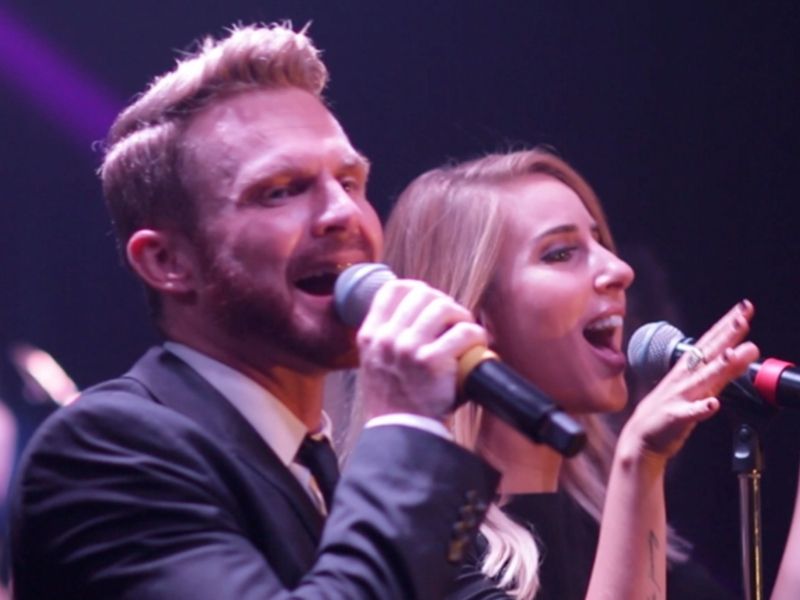
Two of LIV's singers on stage. A company reception can start with one voice and a small band, with the full line-up joining after dinner. Photo: LIV Entertainment Group.
A band on a harbor charter
For a party on the water, the charter operator sets the terms. City Cruises lists the Spirit of Boston at up to 600 guests over four levels, with a dance floor on its Harbor View Deck, and the Boston Elite yacht at up to 150 on two levels, though the operator's own charter guide gives that yacht 140, so confirm the number before the guest list is final. On a boat, the band boards before the guests and cannot leave until the boat docks, so its set length is the cruise length; the operator also decides where the band stands and what power it gets, which the fleet pages don't publish. We ask the operator for both before suggesting a line-up. A duo like Chechi or the saxophonist suits the smaller yacht; the larger boat's dance floor can take a full band.
For company charters, the operator's page for its Odyssey lists DJs and live entertainment among the things an event can include, alongside presentations and company branding, so a band on board is a normal request rather than a special one.
The Boston Harbor Hotel's Wharf Room: a piano already in the room
On the waterfront at Rowes Wharf, the Boston Harbor Hotel describes its Wharf Room as a standalone space of 4,912 square feet with 17.5-foot ceilings, a baby grand piano, an outdoor terrace, a private kitchen, direct garage access and built-in AV from Encore Global. A room with its own AV contractor raises one question before anything else: does the band plug into the house system or bring its own? That answer decides what travels and what the hotel bills, and the hotel's events team settles it, not the band. Direct garage access is the other useful line: the equipment comes in from the garage instead of across the lobby.
A birthday or anniversary at home
For a party in a private house, Boston's Entertainment Licensing office says no license is needed: it doesn't license entertainment on private residential property. The neighbors are the limit instead, through the noise rules in the next section. Chechi, the harp or Deux Cellos fit in a living room; a full band belongs in a tent or a rented room.
A restaurant buyout: whose license covers the band
Private dining rooms are where Boston's birthday dinners and rehearsal dinners happen, and here the license matters. The City's annual entertainment license page says businesses that host live music need one, and the class depends on the band: Live I covers bands or singers with three or fewer performers; Live II covers more than three performers, patron dancing or a DJ. A restaurant licensed only for Live I can host Chechi or a trio, but not a five-piece band and dancing. The Live II fee rises with capacity, from $800 for up to 250 people to $2,000 above 2,000. For any room that holds 49 or more, the same page adds that the building's inspection certificate must list "live entertainment" or "nightclub" as an occupancy, which is why a raw loft or a showroom can't simply hire a band for the night. Ask the restaurant which license it holds before you choose the act. If it holds none, the City's one-time license is the route, explained in the rules below.
Eleven rooms named on this page, ranked by the guest counts their venues publish. Up to about 150 guests, a duo, the quartet or a compact band fills the room; from 150 to about 600, a dance band such as Legendary; above that, Rouge's larger line-ups, whose singers and horns carry to the back tables.
Ceiling height and stage size: the venue-sheet numbers that shape a band's set-up
Guest counts get the attention, but two other figures on a Boston venue sheet decide what the band can build. The first is the ceiling. The Seaport Hotel's meetings brochure gives its Seaport Ballroom a 10-foot-6-inch ceiling over 3,822 square feet, room for 450 standing or 336 seated at rounds, and its Plaza Ballroom at 7,524 square feet under 16 feet, with 648 at rounds or 750 for a reception. At the other end, the Omni's ballrooms rise to 22 and 26 feet and the convention center's Grand Ballroom peaks at 32. The Hynes ballroom, 24,544 square feet, can be split into three rooms seating 906 to 1,408 each, so a band booked for one third of it plays under the same ceiling as the full room. Under a low ceiling, a stage riser, a lighting truss and a dance floor full of raised hands all compete for the same few feet, so the production is planned compact and the lights are hung from what the room already has. Under a tall one, the band can stand higher and the lighting can climb with it.
The second figure is the stage. Few hotel sheets publish one, but the Hynes does: its auditorium holds more than 4,000 people, or 6,000 with Hall C, with a 32-by-48-foot stage in the combined layout. A stage that size takes a large Rouge line-up with room for choreography. In a hotel ballroom the stage is a riser, and the floor plan has to show its width and depth before the guest tables are placed. The Langham's Wilson Ballroom, on the hotel's second floor, seats 170 or holds 200 for a reception according to its venue page, a size where a seven-piece band and a dance floor share one end of the room.
The same Boston rooms by ceiling height, from each venue's own sheet. Below about 16 feet, plan a compact riser and lighting hung from the room; above 30, the production can build upward.
Planning a company night at the convention center, the Seaport hotels or on the water? Tell us the venue and we start on its vendor paperwork.
The city and state rules a band runs into in Boston, and how early each needs handling
Most weddings and company nights in a hotel never touch these rules, because the venue's own license and contracts cover them. They start to matter when the party is outdoors, in a space that doesn't normally host music, or next to people's homes. Here is each rule with its source, and what it changes for the band.
Boston Municipal Code 16-26
Noise limits: 70 dBA by day, 50 after 11 p.m.
The city code treats noise above 50 dBA between 11 p.m. and 7 a.m., or above 70 dBA at other hours, as unreasonable, measured no closer than the lot line of a residential lot or the nearest affected home. Amplified sound plainly audible 100 feet from its source also counts. The City's noise page says the Boston Public Health Commission administers it.
For the band: an outdoor party near homes ends its amplified music before 11 p.m., or moves the late set indoors.
Air Pollution Control Commission
In residential districts, evening means 50 dBA
The Commission's noise regulations set 60 dBA in the daytime and 50 dBA at all other times at the lot line of a residential lot, and they define daytime as 7 a.m. to 6 p.m., every day except Sunday. In those districts, then, an evening reception is held to the night figure from 6 p.m., and a Sunday party all day. The Commission can also grant permits and variances, a variance lasting a year at most.
For the band: a garden or tent party in a residential street suits acoustic acts after 6 p.m.; a dance band plays indoors.
Parks rules, Code 16-19.2
Amplified sound in a city park takes the Mayor's permit
Boston's parks rules bar loudspeakers and other amplification in public grounds without a permit from the Mayor. On the Common or the Public Garden, or for an event drawing more than 500 people within 1,000 feet of a home, the permit is invalid unless the City Council approves it.
For the band: a public park is a long-lead plan; most private parties are better served by a venue with a terrace or lawn of its own.
Boston Parks special event permit
The application asks for the amplified-sound hours
The Parks special event application asks for the start and end times of any amplified sound and a certificate of insurance for at least $1 million in general liability, with the City as additional insured. It also notes that the Boston Common Management Plan asks for no amplified sound on the Common before 10 a.m., except for sound checks.
For the band: the band's set times go straight onto the application, so they are fixed before the permit is filed.
Massachusetts DCR
State parks: apply 45 days ahead
Parks run by the Commonwealth's Department of Conservation and Recreation sit outside the City's system. The state's special event permit page names concerts and small weddings, asks for the application at least 45 days before the event with a $45 fee, and wants a $1 million liability certificate naming DCR at least 14 days before. Commercial applicants also pay a venue fee, $250 a day for a small event of 100 to 500 people.
For the band: confirm whether the park is City or State land first; the deadlines are different.
One-time entertainment license
A room with no license of its own
For a one-off event in a space that doesn't hold an entertainment license, the City issues a one-time license. The application goes in at least two weeks ahead, the police district captain signs it in 3 to 5 business days, and the City estimates 3 to 4 weeks from start to finish. The fee runs from $25 under 250 people to $200 above 2,000. Licenses are issued the week before the event. Larger outdoor events, or unlicensed spaces that need other City permits, file a Public Event Permit instead.
For the band: a gallery, loft or office party without a license needs this a month out, before the band's travel is booked.
Who answers a complaint on the night
The City sends different complaints to different offices. Its noise page directs loud parties and sound amplification to 9-1-1 or the local police precinct, and complaints about restaurants, bars and concert venues to Entertainment Licensing. At a party in a home or a yard, the call goes to the police; in a licensed restaurant or hall, it goes to the office that issued the venue's license. The code's disturbing-the-peace section, 16-26.6, names bands directly but exempts any band or event holding a valid license or permit from a City department, which is one more reason to have the license in hand rather than in the mail.
Outdoor party, park or unlicensed room? Send the address and the date, and we tell you which of these applies before you commit.
From our office in Culver City to a curb in Back Bay: the trip, the curb and the costs around the band
LIV's office is in Culver City, California, and its acts travel to Boston for each booking. That trip is the one cost a Boston client pays that a Los Angeles client doesn't, and it has three legs.
Leg 1
The flight east: 2,611 miles and three hours lost
Southwest lists the distance between Logan and LAX at 2,611 miles. With the clock three hours ahead in Boston, a band that leaves California in the morning reaches Boston in the evening, so for an evening event the players should land the day before, not on the day.
Leg 2
Logan to the venue, with the gear
Getting the players to Boston is the easy part; the instruments and the sound system take the planning. The equipment plan is made per venue, after reading its rules on power, docks and outside vendors, which is why we ask for the venue before anything else.
Leg 3
The last fifty feet: a legal place to stop
A hotel with a dock solves this on its own. A townhouse, a gallery or a restaurant on a narrow street does not. Boston's moving-truck permit is only for moving trucks, not deliveries, so a band's vehicle needs a street occupancy permit to hold curb space: apply at least seven business days ahead, with a traffic plan and a plan for a Boston police detail.
Costs that come from the room and the City, not the band
We don't publish set prices: a quote depends on the number of players, the hours, the date, the production and the travel from California, which our Chicago page breaks down for a fly-in date. A Boston event also carries charges that belong to the venue or the City, and they are worth budgeting before the band's quote arrives so the two aren't confused:
Load-in coverage at the library. The Central Library's 2025 guide estimates load-in and load-out coverage at about $1,500 on top of the space fee.
Curb space. The street occupancy permit has a $50 base fee, ten cents a square foot per day for the first 500 square feet, $20 per meter per day and a $5,000 surety bond, according to Public Works.
Venue membership. Artists For Humanity requires individual and company hosts to take a $1,000 membership.
Weighing a full band against a smaller line-up? Tell us the guest count and we price both, travel included.
Boston addresses by ZIP code, Charlestown to Hyde Park
The list covers the City of Boston, its neighborhoods (Dorchester, Roxbury, Jamaica Plain, Allston, Brighton, East Boston, South Boston, Charlestown, Hyde Park, Roslindale, West Roxbury and Mattapan) and the post-office-box and single-business codes downtown. The City rules on this page, from the noise code to the entertainment license, apply inside these codes.
All 50 Boston ZIP codes
02108
02109
02110
02111
02112
02113
02114
02115
02116
02117
02118
02119
02120
02121
02122
02123
02124
02125
02126
02127
02128
02129
02130
02131
02132
02133
02134
02135
02136
02137
02163
02196
02199
02201
02203
02204
02205
02206
02210
02211
02212
02215
02217
02222
02241
02283
02284
02293
02297
02298
Next door, not in Boston: 02151 (Revere) and 02152 (Winthrop) are their own towns, and 02467 (Chestnut Hill) also covers addresses outside the city line, so check which town a venue there belongs to.
Planning questions from Boston couples and companies
Cost, roles and the first steps; each venue's and the City's rules are in the sections above.
How much do Boston wedding bands cost?+
LIV doesn't publish a price list, because the figure depends on choices you make: how many players, how many hours they play, which day of the week, what sound and lighting the room needs, and the trip from California. For a fly-in date, the size of the line-up moves the price most, since every player adds a seat and a room. A six-piece Rouge with two singers, a line-up LIV has used at a wedding, costs less to bring east than the 18-piece show, and a duo such as Chechi costs less again. Give us the date, the venue and the guest count on the contact form and the quote comes back with each of those lines shown.
Do you provide wedding musicians in Boston for the ceremony itself?+
Yes; the ceremony players are in the second lane of the roster above. If the ceremony is in a church, ask the church about its own rules on outside musicians and amplification before you choose between strings and a soloist, and send the processional, signing and recessional songs early so an unusual request can be arranged for the instruments.
Can a band and a DJ split our Boston reception?+
Yes. Rouge's page describes the band and a DJ booth sharing one stage, with the band opening the floor and the DJ taking over, timed so the floor doesn't empty. The LIV DJ Band in the roster keeps instruments beside the DJ all night, and the DJs on their own are on our Boston DJ page.
Is LIV a Boston entertainment agency?+
No. LIV Entertainment Group's office is at 2651 Fairfax Ave. in Culver City, California, and it books the bands, DJs and musicians that travel to Boston for each event. Eleven of the twelve acts above have their own profile pages with videos, so you can watch the band you are booking; the LIV DJ Band is booked through our DJ roster.
Is amplified music allowed at a Boston Harbor Islands party?+
Only quietly. The state's park listing names "No amplified sound" among its restrictions, and the islands' group page says after-hours, tented or catered events need a Special Use Permit, with groups of 25 or more booking ferry tickets through Boston Harbor City Cruises. Boston Harbor Now's private events on Spectacle Island come with a private round-trip ferry and the island to yourselves. That makes the islands a place for acoustic players who can carry their instruments onto a boat, with the dance band waiting on the mainland.
Is there a private event band for a Beacon Hill or Back Bay house party?+
Yes. The rules for a party in a house, and the acts that fit a living room, are in the private-party part of the company section above. For the quote, add the street address and how close the nearest neighbors are.
Will you travel to a venue in Cambridge, Brookline or another town near Boston?+
Yes. The booking works the same way; what changes is the rulebook. Each Massachusetts city and town has its own noise rules and licensing, so the Boston ordinances and permits on this page don't apply across the line. Give us the street address of the venue, and the town's own ordinances get checked before the quote.
What do you need from us to send a quote?+
The form on our contact page takes about a minute: the state, whether the date is confirmed, the date, whether you have a venue and where it is, the city, the type of event and a rough budget. We reply within one business day with availability and pricing. If you already know which act you want, name it; if not, the guest count and the room are enough for us to suggest one.